Flying is a hassle and it’s bad for the climate. So, where can you go in the UK to get the sense of wonder that comes from the best trips abroad? Here are ten suggestions you can reach without a car. Plus, we’ve listed some alternatives that might be more local.
UK places that feel like you’re abroad
Explore a variety of stunning spots without a car


1. The Norfolk Broads
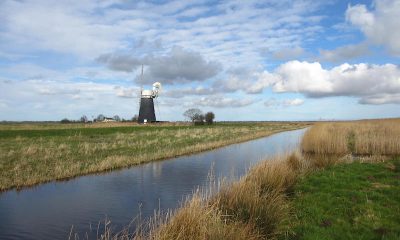
The huge, flat expanses of the Norfolk Broads are ideal for creating a sense of Holland’s windmill-dotted polders. The Norfolk coast is as near to the Netherlands as it is to London.
Wool was exported through the Broads to medieval Flemish weavers. Thousands of Dutch Protestant refugees settled in the area, bringing distinctive gables. It was also Dutch engineers who oversaw the draining of fens. Strangers’ Hall in Norwich tells the story of the city’s historic Dutch community.
Walk some of the 60-mile Weavers’ Way to explore the meadows, reed beds and isolated windmills between Cromer and Great Yarmouth. Enjoy a wilderness of birds, racing hares and deer.
- Get there: Regular trains from Norwich to Great Yarmouth travel through the wild marshes. To get straight out into the wilderness, take one of the trains that stop at Berney Arms, a station with no roads or houses – just a railway and long distance paths. You could walk along the River Yare to Great Yarmouth (about five miles) or cross-country to Acle (about six). Look out for thousands of pink-footed geese flying overhead.
- Refreshments: Eat your broodje kaas (cheese sarnie) with gouda on the bench near Berney Arms Windmill, four miles from the nearest road. For a bowl of sustaining clam chowder, head to the Beach Hut in Great Yarmouth. Here you can eat outside facing a long, level beach stretching out to the distant sea.
- See our adventures around Norwich and Norfolk.

2. Harrogate Stray in Spring, Yorkshire
A flowering avenue of frothy pink, shedding a few delicate petals onto the grass below. This creates what the Japanese call mono no aware, an empathy for the transient beauty of life.
But there’s no need to fly to Yoshino to appreciate sakura season. Instead, head to Harrogate Stray in April to see cherry trees in bloom.
Two long avenues, planted to celebrate the Queen’s coronation, flower briefly but spectacularly each spring.
- Getting there: The Stray is a ten-minute stroll from Harrogate Station. While in the area, don’t miss the little pagodas, bamboos and azaleas in the Valley Gardens and, beyond them, the spring displays at Harlow Carr.
- Refreshments: On cobbled Montpellier Street, ten minutes’ stroll across the grass from the blossoming cherries on the Stray, a small Japanese restaurant called Domo serves everything on their menu to take away. This includes Bento boxes with miso soup and tempura prawns.
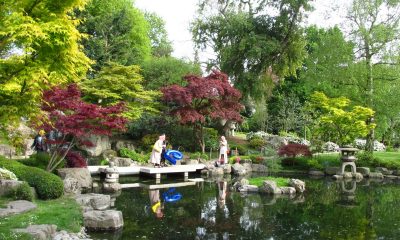
- Alternatively, Londoners need look no further than the Royal Parks for cherry blossom. Regent’s Park has some good displays and there’s a hidden Japanese garden with waterfall, bridges and lanterns on an island in the middle. Even better, the Kyoto garden in Holland Park has maple trees, calm ponds and koi carp. For some of the capital’s earliest cherry blossom head to Stradella Road near Herne Hill station in late March.

3. Brighton Pavilion and Saltdean Lido, East Sussex
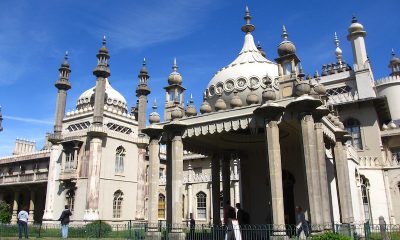
George IV’s seaside pleasure dome, Brighton Pavilion, redesigned by John Nash in the early 19th century, celebrates the Indo-Saracenic architecture fashionable in Regency Britain.
Nash copied elaborate towers, minarets and cusped arches from Mughal mosques and tombs like the Taj Mahal.
Inside, there’s the largest public display of Regency bling. Chandeliers hang from silver dragons’ claws. Gilded dolphins decorate the music room’s six porcelain pagodas. Even the kitchen sports copper palm trees. Follow Good Journey’s directions to the adjacent museum and gallery.
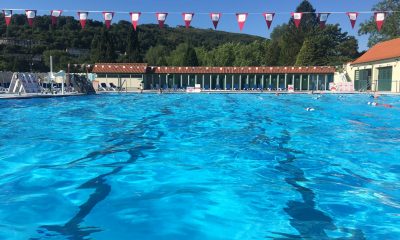
For a real holiday feel, hop on regular bus 12 from almost outside the Pavilion to iconic Saltdean Lido. There are more car-free things to do around Brighton in our car-free guide.
- Getting there: The pavilion is about twenty minutes’ attractive downhill stroll from the station. Bus 12 and others will also get you there.
- Alternatively, check out lidos all over the UK with our car-free guide. And for authentic tastes from Asia, stroll along Leicester’s Golden Mile. Here you’ll find colourful jewellery and fabric shops, embroidered kurtas and saris, and enticing wafts of garlic and ginger.
4. Portmeirion, Gwynedd
A Mediterranean piazza with colonnade and fountain. A jumble of domes, campaniles and villas in pink, turquoise and terracotta. Seventy acres of subtropical woodland above white sandy beaches. Amalfi? No, Portmeirion village, which stands on the Dwyryd Estuary near Cardigan Bay.
The village was designed by Clough Williams-Ellis over five decades from 1925. It incorporates rescued architectural features and buildings, from pagodas to neoclassical colonnades.
- Get there: From Minffordd railway station, walk past Castell Deudraeth and follow the footpath along the field below it.
- Refreshments: Several on-site places to get food. Caffi Glas has seats outside and offers classics like pizza Napoletana. Try a take-away cornet from Caffi’r Angel, the village’s Italian-style gelateria.
- Alternatively, for glimpses of Italy in London, try the Italian church and deli in Clerkenwell or wander round Little Venice. Birmingham, famously, has more canals than Venice and several cities (like Leeds and Bristol) use their waterways as an enjoyable means of transport…
5. Mayfield Lavender, Surrey
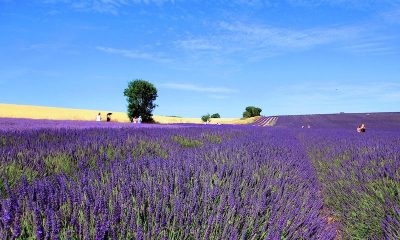
Provence is not the only place you can see those buzzing violet fields, their neat, fragrant rows converging towards the horizon. There are champs de lavande dotted across the English and Welsh countryside, too.
Mayfield Lavender Farm opens on June 1st and the slopes turn purple in summer.
- Getting there: Take the train from London Victoria to East Croydon or Purley, then hop on bus 166 to Oaks Park in Carshalton Road.
- Refreshments: Cream teas, sandwiches, drinks and cakes at the on-site café.
- Alternatively, there are also lavender fields in Yorkshire, Norfolk, Somerset, Shropshire, Warwickshire, Powys, Surrey, Sussex, Kent, Hertfordshire and Hampshire.
6. Camel Valley Vineyard
The Camel Valley Vineyard has a room full of prizes from recent years (literally hundreds of them since 1993). Their Cornish fizz has beaten Bollinger in blind taste tests. The Pinot Noir sparkling Rosé scooped the International Wine Awards gold medal and trophy in 2014.
Drink to their success while sitting on the slate terrace, above sloping, green vines looking across the valley towards the distant woods and downs. There is a tour every weekday afternoon, taking in the state-of-the-art winery and a glass of still wine.
For more adventures in the area, see our car-free guide to Bodmin.
- Getting there: The vineyard is right on the Camel Trail cycle path, a couple of miles west of Bodmin so it’s easy to cycle there (or walk if you keep an eye out for bikes!). But if that sounds too energetic, it’s only a lovely, leisurely mile along the beautiful valley from Boscarne Junction on the Bodmin and Wenford steam railway. The station is right next to the trail so – with a little bit of forward planning – you can continue on foot, have a glass or two and get a later train back.
- Refreshments: Wine by the glass on weekdays (book ahead). Half way between the station and the vineyard, you’ll find the delightful Camel Trail tea garden, serving crab salads and cream teas in a terraced apple orchard.
- Alternatively, there are vineyards all over England and Wales as far north as Ryedale in Yorkshire. There’s even one near Forty Hall in Enfield on the outskirts of London.
7. St Andrews West Beach, Fife
St Andrews is actually one of the driest places in Britain, with more than 1,500 hours of sunshine and less rain each year than Rome.
Famous as the location for the opening sequence of Chariots of Fire, West Beach is big enough to get away from the crowds. It boasts two miles of dune-backed golden sands. There’s a dramatic ruined cathedral on the cliffs above and the chance of spotting bottlenose dolphins.
The thirty miles of coastline to the south are also spangled with lighthouses, harbours, gardens, caves and castles – and well-served by buses!
Near the village of Elie, a terrifying vertiginous chain-walk skirts the cliffs and rock pools, like the via ferrata or Klettersteige in the Alps.
- Getting there: Get the train from Edinburgh to Leuchars railway station and jump on one of the many regular buses into town, like frequent bus 99. The West Beach starts about five minutes’ stroll from the bus station, past the Royal and Ancient Golf Club. See our guide to Coastal Fife.
- Refreshments: Non-golfers are allowed to eat and drink at the beachfront Swilcan Lounge in the golf clubhouse, with beer from the St Andrews Brewing Company. The less formal Bibi’s café is also close by.
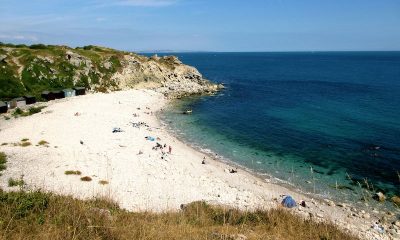
- Alternatively, with more than 5,000 miles of coastline, Britain has hundreds of beaches that (squinting into the sunshine) could pass for the Caribbean. You can find gently curving tree-lined bays of soft white sand and turquoise water (slightly chillier than the Caribbean, admittedly). Cornwall, the Hebrides, Wales and Northern Ireland all have their fair share. A dramatic beach like Luskentyre Sands on the Isle of Harris might be perfect for escaping by ferry.
8. Westonbirt arboretum, Gloucestershire
Giant Redwoods and Californian incense cedars. Caramel-scented katsuras and Australian Wallemias. Autumn colours for Canadian-style leaf-peeping and fiery Japanese maples…
With 2,500 different species of tree, representing landscapes all across the globe, you can travel round the world in an afternoon with a trip to Westonbirt Arboretum.
- Getting there: Just follow the Good Journey directions.
- Refreshments: There’s a café on site.
- Alternatively, admire the exotic trees and waterside maples at the Yorkshire Arboretum.
9. Mountaineering and a cable car in Greenwich
OK, so “mountain” might be a bit much, but there is a (relatively vertigo-free) climb on offer in Greenwich. Climb over the roof of the O2 arena, with daytime, sunset and twilight options.
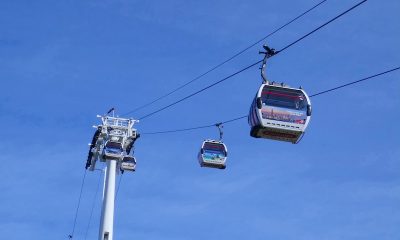
- Getting there: Go to Royal Victoria station on the Docklands Light Railway and ride the cable car high over the Thames. This is well worth doing even if you don’t want to scale the O2. You could then choose to walk along the Thames to Greenwich or catch the boat. See more ideas in our car-free guide.
- Refreshments: Lots of choice, including a floating café on board the Good Hotel near the cable car station on Royal Victoria Dock.
- Alternatively, among other UK cable cars, is the one that flies up to the Heights of Abraham near Derby.
10. The English Riviera, Devon
Palm trees along a seaside prom? Check. Sandy beaches and (often) blue water? Check. Yachts and interesting cultural history? Check: the art nouveau pavilion and the elegant hotels of Torquay have Agatha Christie connections.
The region enjoys a balmy microclimate, in the shelter of Dartmoor. Subtropical plants flourish in Victorian villa gardens. The area is known as the English Riviera, a slightly greyer rival to the Côte d’Azur.
It certainly ticks a few boxes: calm bays, rugged footpaths, and one of the UK’s seven UNESCO-listed global geoparks. The caves and rocky arches certainly give Capri’s Arco Naturale a run for its money.
Queen Victoria described Babbacombe Downs, with England’s highest cliff-top promenade, as having “red cliffs and rocks with wooded hills like Italy”.
- Getting there and around: See our car-free guide.
- Refreshments: Rockfish, with seats outside overlooking Torquay harbour, serves fresh local seafood, chargrilled with salad and chips.
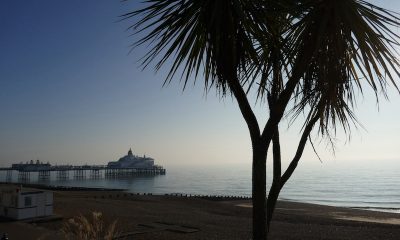
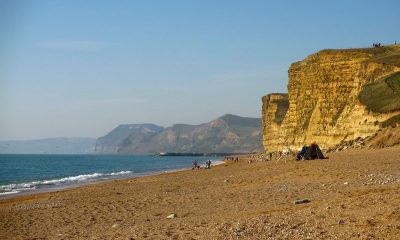
- Alternatively, lots of other seaside towns, can also do a good impression of being somewhere more exotic. Eastbourne (sunniest city in the UK) has palms and Mediterranean coastal flowerbeds. There are glimpses of Riviera-style coastline in Hastings, too – as well as a great art gallery. And the white and gold cliffs of Dorset have often been compared to Malta, Spain, even the Caribbean!