The rich history of Suffolk stretches from prehistoric sites to wartime airfields and beyond. Visit by bus or train and you can enjoy scenic journeys through landscapes shaped by centuries of human activity. You could stroll through the woods and heaths at Sutton Hoo, where ancient East Anglian rulers were buried, or past the forts and Martello towers near Felixstowe. Here are some of the historical Suffolk places you can get to without a car.
History-lovers’ Suffolk
by bus and train


1. Sutton Hoo
The royal burial ground at Sutton Hoo is possibly the most iconic place for history-lovers to visit in Suffolk. A viewing tower above the seventh-century mounds gives you a new perspective on the site and a wonderful interactive museum has state-of-the-art interpretation.
- The peaceful landscapes around Sutton Hoo, with their heathland, woods and wide, tidal river, are part of what makes this such an atmospheric site to visit. Getting there without a car helps keep Sutton Hoo green and tranquil and, as a reward, you’ll get 20% off entry and a free hot drink when you arrive car-free.
- How do I get to Sutton Hoo without a car? Follow Good Journey’s directions. You can walk from Melton station (1¼ miles), mostly beside the road, or catch bus 70 twice a day to the entrance.
- There are related sites to explore in nearby Woodbridge, one stop on the railway or a riverside walk away from Melton. See our guide to Summer in Suffolk for more details.

2. West Stow Anglo-Saxon Village
Another site rich in ancient treasures and excavation stories is the reconstructed Anglo-Saxon village at West Stow, not too far from Bury St Edmunds. Several thatched houses have been built using experimental archaeological techniques. The village is also home to two brilliant museums, where you can see local finds and learn more about site’s amazing history. Look out for neolithic flint arrowheads, Iron-age axes, Roman figurines, antler-carved combs and England’s largest Bronze age hoard!
- The museums throw light on the area known as The Brecks, where a unique combination of factors has created large areas of lowland heath. Centuries of human activity, including sheep- and rabbit-farming, helped create these landscapes.
- It’s a great area for walks – through the heaths and woods and along the River Lark. And there’s a Beowulf and Grendel trail, where sculptures recreate figures from Anglo-Saxon folklore.
- How do I get to West Stow Anglo-Saxon village without a car? Bus 16 and bus 355 both leave from close to Bury St Edmunds railway station and stop, about 20 minutes later, at West Stow Turning. (Make sure the driver knows you want to get off there!) From here, you could simply follow the West Stow sign along the Icklingham Road to the main entrance. Alternatively, take a more interesting route through the heathland, past a carved dragon’s head and other landmarks. Either way, it’s just under a mile from the bus stop.
- For the scenic route from the West Stow Turning bus stop on the A1101, walk along the main road in the direction signed Bury St Edmunds. After about 150m, turn left along a rough lane between trees. Go through a metal gate, marked Private Angling, and turn left beside the lake with water on your right. Exit through the next gate, turn right across the heathland and keep straight, following signs to reach the café and visitor centre. There’s a map here.

3. Landguard Fort, Felixstowe
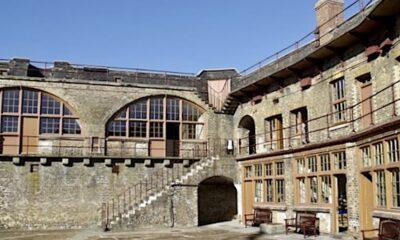
Martello towers were built along the coastline near Felixstowe in the early nineteenth-century to defend against Napoleon’s army. Today, you can still see some of these towers – you might even catch a glimpse from the train window. And, at the end of the peninsula, there’s a huge eighteenth-century fortress. Landguard Fort guards Harwich Harbour and has been the site of some extraordinary military history over the centuries. You can find out about Landguard’s role as an anti-aircraft defence post in the Second World War and explore the labyrinth of rooms and passages inside the fort. People arriving car-free get a free hot drink.
- How do I get to Landguard Fort without a car? Follow Good Journey’s directions. You can take a bus from Felixstowe railway station and the area has lots of interesting walks and cycle routes. You could even get there by ferry!
- The fort also has great views across Felixstowe and the surrounding sea. The buildings next door, with their own interesting history involving submarines, are home to Felixstowe Museum.
4. Lavenham
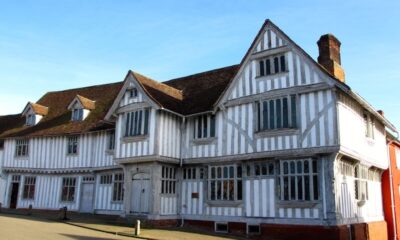
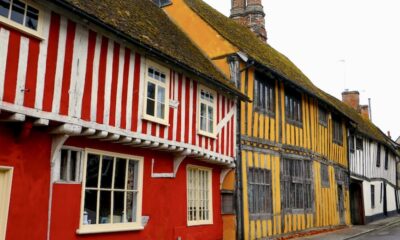
Packed with well-preserved half-timbered houses and medieval mansions, once home to wealthy wool merchants, Lavenham has that time-warp feel about it that draws visitors in droves. Help keep the traffic jams away and arrive by bus and you’ll get £1 off at Lavenham Little Hall.
- Built in the late fourteenth century, Lavenham Little Hall is a trove of historical treasures. It’s one of Suffolk’s oldest timber-framed buildings and has all kinds of features, added over the years like a Tudor fireplace and decorative Persian panels. Don’t miss the garden – you can read more here.
- It’s also worth strolling round Lavenham Guildhall and visiting St Peter and St Paul’s church. Explore the pretty streets of colourful cottages and stop off for refreshments in one of the pubs and cafes.
- How do I get to Lavenham without a car? Bus 753, from Bury St Edmunds to Sudbury, stops hourly in Lavenham Monday to Saturday and four times on Sundays.
5. Parham Airfield Museum
For an interesting glimpse into World War II history, visit Parham Airfield Museum. In a former control tower, you can learn about the bombers, engineers and others who worked in the area. The museum serves as a moving memorial to their bravery and to the 743 who were killed.
- How do I get to Parham Airfield Museum without a car? Follow Good Journey’s directions. For more places to learn about Suffolk’s interesting Second World War history, see this feature.
- Enjoy time-travelling through Suffolk by bus and train!