Whether they are hidden in the dunes near sandy beaches or towering over cobbled lanes and thatched cottages, these very different chapels and churches are all worth visiting. This selection includes quite a few places in East Anglia – an area packed with interesting churches. And a car-free journey to get there is all part of the adventure: a ferry ride, waterside walk, a rural bus ride or an epic coastal train trip.
Amazing churches
around the UK


1. St Enedoc, Trebetherick, Cornwall
The first of our churches car-free is a seaside gem in the middle of a golf course – it was buried in sand dunes for three centuries. The most beautiful way to arrive is via the ferry from Padstow, followed by a mile’s walk along the coast path beside the wide Camel Estuary. The poet John Betjeman loved the church and is buried there.
- How to get to St Enedoc car-free: Bus 96 from Wadebridge stops not far from the church, but the most interesting way to get there is via the Padstow ferry, which runs all year round and then on foot. Depending on tide times, it arrives on or near the beach in Rock. Padstow has buses from Bodmin Parkway Station via Bodmin and Wadebridge, also from Newquay.
- Walking from Rock, follow the South West Coast Path with the sea on your left and the dunes ahead. Go on around the seaward side of Brea Hill and turn right across the golf course towards the wonky tower of St Enodoc’s. See map below.
- You could choose to go back to Rock via a different route over the golf course. The public paths are marked by white stones. Watch out for golf balls!
- Refreshments: in Rock and nearby Polzeath.
- More in the area: See our car-free guides to Bodmin and Newquay.

2. St Peter-on-the-Wall, Bradwell-on-Sea, Essex
One of England’s oldest intact churches, the remote seventh-century chapel of St Peter-on-the-Wall is set on a salty slice of Essex coastline. In 654 St Cedd, a Northumbrian monk and bishop, sailed from Lindisfarne and landed near a ruined Roman fort called Othona. He used stone from the fort to build the chapel, modelling it on ancient churches in Egypt and Syria. Walk beside the wide, wild Blackwater Estuary, with views across the water to beach-hut-fringed Mersea Island. Nearby are shell-carpeted beaches, salt marshes and tidal mudflats, with horned poppies and sea lavender. Look out for plovers, all kinds of geese and ducks, curlews and orange-billed oystercatchers.
- The simple, but impressive chapel of St-Peter-on-the-Wall is always open and still used regularly.
- How to get to St Peter’s car-free: DaRT 4 minibus to Bradwell leaves from Southminster railway station six times a day and goes to East Hall Farm, which is about 15 minutes walk from the chapel along a straight, signed track.
- Refreshments at the King’s Head.

3. Duxford Chapel, Whittlesford, Cambridgeshire
Almost next to Whittlesford Parkway station, just beyond half-timbered Red Lion, Duxford Chapel is a different sort of hidden gem – a small, but calm and beautiful fourteenth-century chantry chapel. It’s managed by English Heritage and open during daylight hours. Fans of church art could also walk a mile from the station to visit Duxford village, where the church of S John’s has some amazing wall paintings.
- How to get to Duxford chapel car-free: Whittlesford Parkway is on the railway between London Liverpool Street and Cambridge. The chapel is a few steps from the station, just behind the pub.
- How to get to St John’s, Duxford car-free: Cross the bridge over the railway and walk away from station. Turn left at the crossroads, cross the main road and continue into Duxford. After the creeper-covered house, turn right into St John’s Street.
- Refreshments: Red Lion by the station or lovely Graystones café (01223 836200) in Duxford.

4. St Andrew's, Much Hadham, Hertfordshire
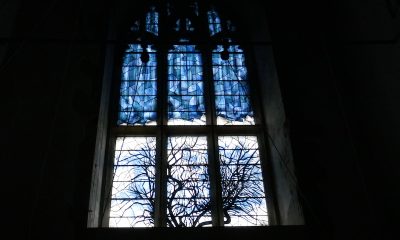
The village of Much Hadham, crammed with half-timbered houses, Georgian mansions and thatched cottages, is well worth a trip. The thin spire is a local feature known as a “Hertfordshire spike”, the two heads by the West door of the medieval church were carved by Henry Moore in 1953 and a tree-of-life stained glass window is based on one of his designs.
- How to get to Much Hadham car-free: Bus 351 from Bishop’s Stortford (or from Ware) stops in the village every couple of house, at the end of the short lane to the church.
- Refreshments: The Bull is a characterful village pub with great food. And Hopley’s cafe (from March onwards) is also a popular lunchtime choice with homemade cakes and imaginative salads.
- More in the area: The seasonal Forge Museum, with its Elizabethan mural, is definitely worth popping into. The Henry Moore foundation is a pleasant walk away through woods and fields. See our car-free guide to Hertford and Ware.
5. St Cyriac and St Julitta, Swaffham Prior, Cambridgeshire
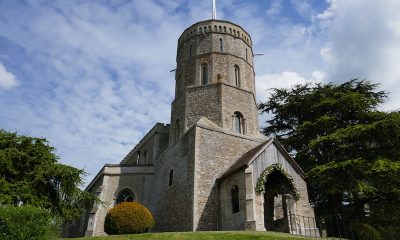
Swaffham Prior, with its big-gardened pub, twin churches and windmills is a great destination. This pair of unusual churches with polygonal church share a raised churchyard in the Cambridgeshire village with a bus from Cambridge stopping nearby and a pub next door. The parish church of St Mary’s is originally Norman and has a 16-sided tower. Look out for two carved medieval faces on the wall inside near the tower arch.
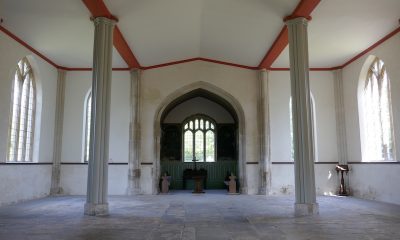
- Elegant St Cyriac and St Julitta, looked after by the Churches Conservation Trust, has a spacious Georgian interior and fifteenth-century octagonal bell tower. There are pop-up teas in summer and visitors can even rent to the church for champing.
- How to get to Swaffham Prior: Bus 11 runs regularly from Drummer Street bus station in Cambridge towards Newmarket and beyond, stopping in Swaffham Prior at Vicarage Lane near the church.
- Refreshments: Red Lion pub in Swaffham Prior.
6. St George's, Portland, Dorset
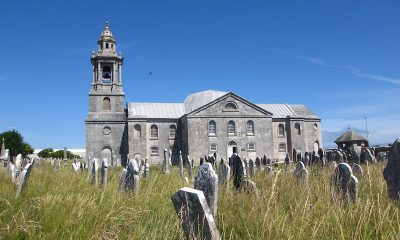
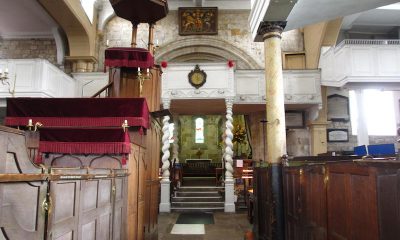
Another eighteenth-century relic is clifftop St Georges, set on a breezy headland with occasional wind-sculpted trees. It has an evocative time-warp Georgian interior of box pews and twin pulpits (one for readings and ones for sermons). Nikolaus Pevsner called it Dorset’s most impressive eighteenth-century church. Thomas Gilbert built it; his grandfather supplied the Portland stone that built St Paul’s Cathedral.
- How to get to St George’s: Take bus 1, which runs frequently from Weymouth’s King’s Statue (Stop K4) towards Southwell. Get off half an hour later at the George. The church is just a few steps away, across the road.
- Refreshments: Beyond the nearby George Inn, there are more options five minutes’ walk away in Easton, like the arty White Stones with its gallery and garden full of sculptures.
- More in the area: A short walk away, down a wooded path, ruined St Andrews has overgrown graves carved with piratical skulls and crossbones. See our guide to Weymouth for further car-free ideas.
7. Rosslyn Chapel, Roslin, Midlothian
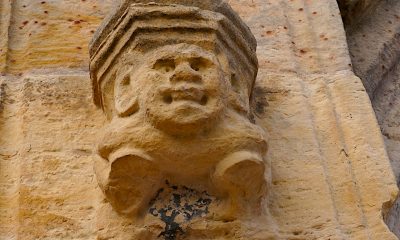
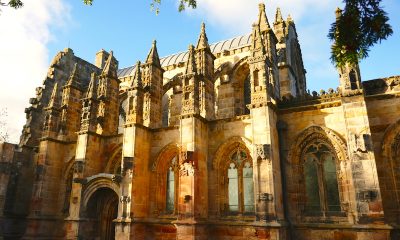
Dan Brown’s novel and the film that was based on it, The Da Vinci Code (2006) transformed the fortunes of this once-crumbling chapel not far from Edinburgh. The book sold more than 80 million copies and visitor numbers rocketed, bringing income for much-needed repairs; staff refer to it as “the Rosslyn miracle”. One clue in the Da Vinci Code reads: “The Holy Grail ‘neath ancient Roslin waits./ The blade and chalice guarding o’er Her gates./ Adorned in masters’ loving art, She lies./ She rests at last beneath the starry skies.” Fifteenth-century Rosslyn is indeed elaborately decorated with a multitude of incredible, medieval stone carvings, which are definitely worth seeing even if you’re not a Dan Brown fan.
- Rosslyn Chapel is now a popular visitor attraction with a shiny new visitors’ centre, open all year round (times vary).
- How to get to Rosslyn Chapel: Bus 37 from Edinburgh’s North Bridge (five minutes from Waverley Station) runs regularly towards Penicuik or Gowkley Moss. Get off, after about 45 minutes, at the Original Rosslyn Hotel and walk for a couple of minutes in the direction the bus was headed.
- Refreshments: for visitors in the Rosslyn Chapel Coffee Shop with lovely views across wooded Roslin Glen.
- More in the area: Don’t miss the ruined castle, ten minutes’ walk round the corner, in a lovely woodland setting. For more ideas, see our car-free guide to Edinburgh.
8. St Mary's, Whitby, Yorkshire
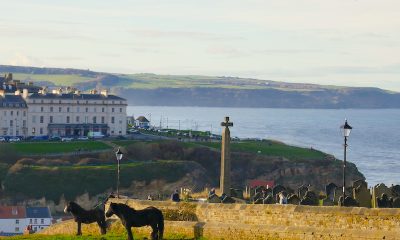
An epic bus ride across the North York Moors from Malton or a shorter one up the coast from Scarborough brings car-free visitors to the colourful town of Whitby. The bus station is next to the harbour, where an old swing bridge over the River Esk links the two sides of town. Cross over and head up the 199 steps to the church and abbey at the top. Don’t rush past eleventh-century St Mary’s church in your rush to reach the abbey without at least a glance inside at the 18th-century box pews and galleries. Outside, look out for the tall sandstone Celtic cross in the corner of the churchyard, put there in 1898 in honour of the local Anglo-Saxon poet, Caedmon. The graveyard features in Dracula; Stoker describes the view obscured by cloud until the church and abbey are suddenly lit “by a narrow band of light as sharp as a sword-cut” and something dark standing in the shadows: “whether man or beast, I could not tell.”
- How to get to St Mary’s Whitby: Ride the Coastliner bus all the way from York. Or the X93 from Scarborough and then climb the picturesque stone steps to the church and abbey at the top.
- Refreshments: Abbey House tearooms next door.
- More in the area: See our car-free guide to Scarborough and Whitby for more suggestions.
9. St Bees Priory, Cumbria
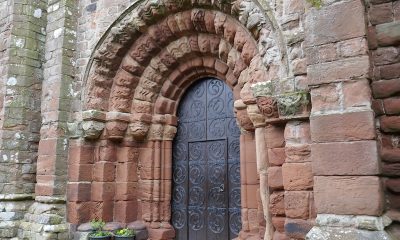
This twelfth-century Cumbrian church, close to the start of Alfred Wainwright’s challenging Coast to Coast walk, was an important theological college for many centuries. There’s a huge zigzag-framed Norman doorway, effigies of crusading knights, medieval carvings and more.
- How to get to St Bees Priory: It’s just a five minute walk from St Bees railway station, on the Cumbrian coast line between Carlisle and Barrow. Simply walk towards the village to find it on your left.
- Refreshments: Hartley’s tea rooms on the cliffs, about half a mile away, has a view of St Bees Head from the window.
10. St Tanwg's, Llandanwg, Gwynedd
The little church of St Tanwg, hidden among the marram grass and wildflowers of the dunes at Llandanwg, dates from the thirteenth century. But there are relics here from even further back in history, including a stone with Roman letters. Nearby, the tidal estuary of the River Artro is dotted with boats and home to numerous wading birds.
- How to get to St Tanwg’s: From Llandanwg station (on the Cambrian Coast Line), turn left along the road and you’ll reach it.
- Refreshments: Y Maes café next door.
- In the area: St Tanwg’s is right on the beach at Llandanwg and a perfect starting point for some lovely station-to-station walks along the Welsh Coast path like the three miles beyond the station to Harlech, along a wide sandy beach. More ideas in out car-free guide to Barmouth, ten miles south.