Space rockets, steam trains, and King Richard III, spicy food and sequinned saris… the city of Leicester is a varied and fascinating destination, spanning continents and centuries. Birthplace of Adrian Mole author Sue Townsend and footballer Gary Lineker, childhood home of naturalist David Attenborough and his actor brother Richard, Leicester continues to make history in sport, science and culture. It’s packed with murals, markets, memorials and museums and features a buried king, a planetarium, and the UK’s largest collection of German expressionist paintings. It takes just over an hour to reach the city from London St Pancras and 17 minutes from East Midlands Airport; regular trains arrive from Sheffield, Birmingham and beyond.
Leicester
Leicestershire


1. Blast off to the National Space Centre
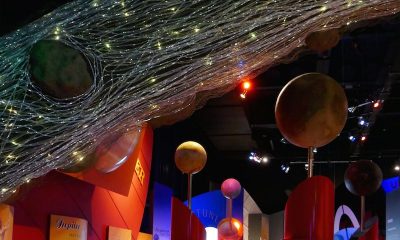
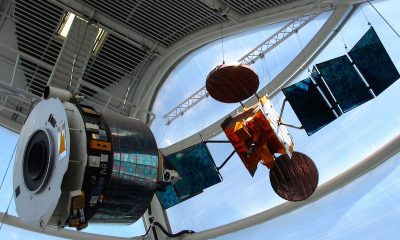
Walk into a model of the solar system or a replica of the Columbus Module from the International Space Station. Operate a remote-control rover on the mocked-up surface of Mars, become an on-screen weather forecaster, or find out if you have what it takes to be an astronaut. Leicester University’s scientists, who helped develop this huge museum, have been involved with space for decades and cooperate on international projects at their Space Research Centre, opened in 1988.
- The National Space Centre, built with a millennium grant, reflects a mission to share the excitement of this research with a wider audience: six interactive galleries orbit a central planetarium.
- Don’t miss the show here – a brief history of everything, from the big bang to human evolution narrated by Andy Serkis, who played Gollum in Lord of the Rings.
- Bus 54 runs frequently (less so on Sunday) from Leicester’s Haymarket bus station to stop just six minutes’ walk away from the Space Centre. Get off after about 15 minutes at the stop called Abbey Lane. Cross the main road and follow Exploration Drive past Asda. Follow Good Journey’s directions.
- The brick chimney next door marks Leicester’s Science and Tech museum, housed inside the old Abbey Pumping Station. It has displays of industrial and scientific heritage and is free.
2. Explore Abbey Park
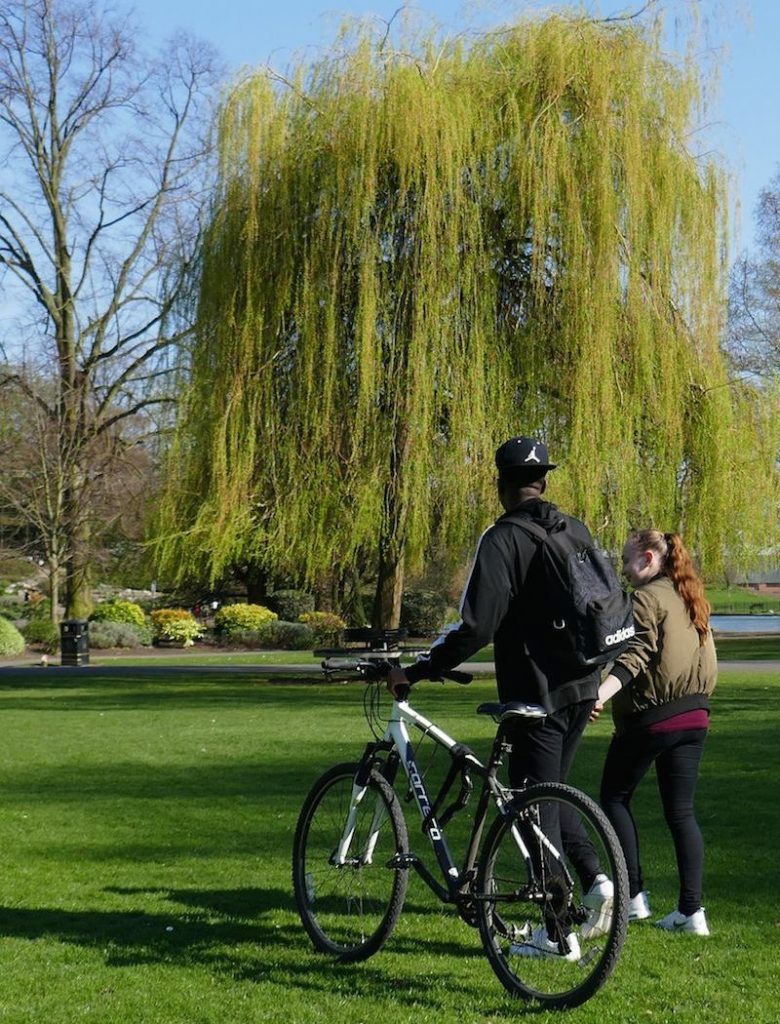
On the bus to the Space Centre, you pass neighbouring Abbey Park – a great place to picnic on the grassy riverbanks. You can walk back there from the Space Centre: simply turn left past Asda and keep straight over the main road to find the arched gateway on your left.
- On one side of the River Soar, you’ll find the remains of 12th century Leicester’s 12th-century abbey; across the water, are a Victorian boating lake and gardens and a miniature railway.
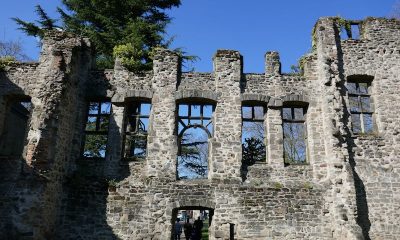
- Walk ahead past Pet’s Corner and the atmospheric ruin of 17th-century Cavendish House and head right along the curving line of trees towards the cloister garden. You can see the abbey’s largely-demolished walls nearby.
- At the café, turn left across the beautiful medieval bridge. From here you can wander right through the flowers or left past the lake and bandstand. You can even hire a boat in the summer.
- Keep heading towards the far left corner and exit, just beyond the car park, back onto Abbey Park. Turn right over the Grand Union canal. There’s a bus stop here, where you can catch the 54 back into town, or you can keep straight on for the next adventure.

3. Stroll down the Golden Mile
Sparkling jewellery shops, multi-coloured fabrics, embroidered kurtas, enticing wafts of garlic and ginger… Leicester’s Golden Mile (Belgrave and Melton Roads) will bring you a taste of India in the heart of England. You can walk there from Abbey Park (see 2 above) or simply catch bus 4 or bus 5 from Leicester’s Haymarket bus station.
- Soon, you’ll find yourself transported to the subcontinent. There are colourful racks of bangles, shops full of saris or spices, cafés, temples and a statue of Mahatma Ghandi. The area’s Diwali celebrations every autumn are the largest outside India, boasting fireworks, fairground rides and Bollywood dancing.
- Stock up with silver-leaved sweets or tasty pakoras at popular Sharmilee or try a crispy South Indian-style dosa pancake (they’re almost as wide as the table!) at Dashkin over the road.
- Catch h bus 4 or bus 5 back into town for more adventures.

4. King Richard III Visitor Centre
The last English king to die in battle, last of the Plantagenets before the Tudor age began, part of Bosworth’s final charge of knights in full armour… King Richard III’s death marked, in many ways, the end of the medieval era and start of the Renaissance. The story of his life, death and re-discovery is animated and illuminated in Leicester’s King Richard III Visitor Centre.
- The visitor centre stands on the site of a medieval friary, where the king’s remains were hastily buried more than half a millennium ago.
- In 2012, a complex excavation unearthed Richard III’s skeleton and, using DNA testing, matched it to modern descendants of the long-dead king.
- Besides charting the king’s dynastic and military operations, the exhibition examines Richard’s murderous reputation and manipulated legacy, as well as the science that meant such ancient DNA could be genome sequenced for the first time ever.
- Richard’s original burial place has been preserved under a glass floor and visitors can see exactly where he was found (under what was then a car park), during an archaeological search that caused international excitement.
- The Visitor Centre is open daily.
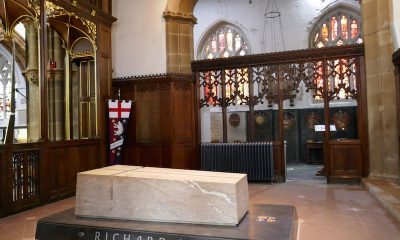
- Leicester Cathedral, where Richard III was re-buried in March 2015, is next door, with a statue of the embattled king nearby. Overlooking the new tomb are two stained glass windows by Thomas Denny, glowing scarlet and ochre behind the simple limestone grave.
5. Walk (or ride) through history
The medieval city that Richard III would have seen is still visible in corners of modern Leicester. In some places, the remnants date back even further like the wall of a Roman bathhouse or the mound of Leicester’s first Norman castle. There’s more recent history here too: a Victorian clock tower stands in the heart of town and a working heritage railway runs up to Loughborough. This map will help you find things.
- Right next to the Norman cathedral, the half-timbered medieval Guildhall is free to visit and full of interesting details: stained glass, wood panels, portraits of former mayors, and a gibbet for hanging corpses in the cells
- Head diagonally right across Jubilee Square to find St Nicholas church, Leicester’s oldest place of worship; behind it is the wall of a Roman bathhouse, known as Jewry Wall.
- Follow the main road round to the river and turn left along the riverbank to find what’s left of Leicester castle in a lovely riverside garden.
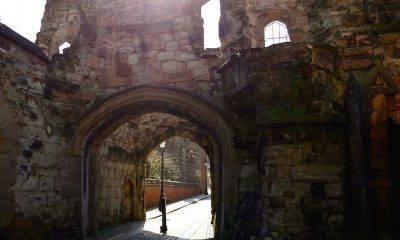
- Nearby, there are two ancient gateways and the church of St Mary de Castro, where the medieval poet Geoffery Chaucer married his second wife, Philippa de Roet, lady-in-waiting to Edward III’s queen.
- There’s currently an interesting mural on the wall of Newarke Houses, between the two archways, featuring Thai imagery. It celebrates Leicester City’s football club – nicknamed “the Foxes” and owned by Thai businessman Vichai Raksriaksorn). Leicester City F.C. won a historic premier league victory in 2016, having started as 5000-1 outsiders. The club’s stadium is less than a mile upstream along the River Soar.
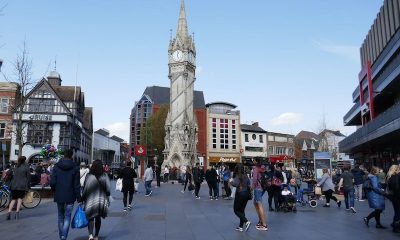
- Heading back through the Old Town, you’ll reach Leicester’s colourful market, open all day Monday to Saturday. Turn left at the information centre to find the clock tower, not far from the bus stations.
- If you love heritage trains, don’t miss the Grand Central Railway to Loughborough. A rover ticket will let you ride all day when the trains are running – mostly weekends and holidays – puffing through the villages up to Loughborough. The 127 bus from Leicester’s St Margaret’s Bus Station runs close to both Loughborough and Leicester North Stations, at each end of the steam railway.
6. Bus to birds and battlefields
History and wildlife enthusiasts could take a day trip west out of town on the 153 bus (also from Leicester’s St Margaret’s bus station) to Market Bosworth and walk through the historic countryside to Bosworth Battlefield Heritage Centre. The Richard III Centre offers joint tickets.
- The beamed Tithe Barn café offers full English breakfasts, pasties, jacket potatoes, homemade soup and more.
- Nearby, there’s another steam railway – the Battlefield Line, which chuffs its way from Shenton to Shakerstone via Market Bosworth.
- On the way, the 153 bus also passes close to the moated remains of Kirby Muxloe castle; to visit it, hop off the bus at Main Street in the village of Kirby Muxloe and walk for half a mile along Main Street, past the Royal Oak pub, until you reach the castle on your right.
- Twenty minutes further on along bus route 153, you reach another Main Street – in the village of Desford, home to Tropical Birdland, full of exotic silver-cheeked hornbills, laughing kookaburras, blue & gold macaws or citron-crested cockatoos. There are walk-through aviaries, a play area, a café and three adorable pygmy goats.
- To visit the Tropical Birdland, get off just after the Bluebell Inn, find Main Street and follow it left to sloping Lindridge Lane.
7. International art … and food
Back in town, there’s always more to see. The neoclassical New Walk museum, at the end of a leafy pedestrian avenue (New Walk) near the station, has the UK’s largest collection of paintings by German Expressionist artists and a roomful of pottery by Picasso.
- Downstairs, this Victorian museum has classic ancient Egyptian and natural history collections: there’s a dinosaur skeleton towering over one gallery and a mocked-up mummy crashing out of a wall in another.
- David Attenborough helped classify fossils as a kid in this museum, fostering his lifelong passion for the natural world. His older brother Richard loved it too – he also collected the Picasso ceramics over decades and lent them to the museum.
- Upstairs, there’s art from the 18th to 20th centuries and a changing selection of colourful works by Wassily Kandinsky, Franz Marc and many others.
- Stroll back up New Walk, turn right at the end and second right again into Albion Street to find locally-famous Italian food behind the unassuming green door of Casa Romana.
- For a great coffee shop that stays open past teatime, try 200 Degrees on nearby Market Street – they have gluten free lemon and courgette cake, sprinkled with pistachios.
- In Leicester, you can eat your way around the world. Researchers recently identified Narborough Road, in the south west of the city, as the UK’s most multicultural street. Sample charcoal-grilled lamb chops in Istanbul or a paneer sizzler and mango lassi at Mithaas.